Squeaky clean

I started making soap before the pandemic mostly because I learned that the soap we wash our hands with every days isn't technically soap. It's made of synthetic detergents and surfactants and while that's not necessarily bad, I wanted to try to make the soap that had supported humanity for thousands of years. Also, it's relatively simple chemistry and I thought, "Why not?". I had used caustic chemicals in labs before, so I understood the need for proper PPE (personal protective equipment) and I knew I could follow a recipe.
I took to the internet for some guidance, sifted through mountains of info and made my first batch of soap. It was a liquid soap made of olive and coconut oils. It lathered ok and was a light amber color, but it was thin and would shoot out of the pump (all over the kitchen). I learned that I could thicken it with the addition of saturated salt solution. When I added the brine to the soap, it would form these long strands of goop that I referred to as "boogers". (My children were very young at the time and this was an oft-used term in our household.) Eventually the goop would dissolve in the soap and ultimately thicken the solution to the consistency of conventional soap. So it worked, but it was an extra step, and it was a time consuming process.
Fast forward years later. I've made liquid and bar soap from a range of oils and animal fats (all leftover from meats we prepared as meals for our family). I learned that lemon essential oil precipitates out of liquid soap and imparts no smell. This was sad for me because I love the smell of lemon. I learned that liquid soap made from animal fat rendered in my kitchen has sediment in it that makes it clog up soap pumps. I also learned that I could dilute my liquid soap 200-300% in water and dispense it with a foaming pump. It was so easy and economical! One batch of hand soap can last an entire year for two bathrooms and a kitchen sink. But I wanted to try a pure coconut oil liquid soap because the lather would be better than the olive/coconut oil mix and it would be clear/white instead of yellowish. So I looked up the ratios, wrote down my formula, donned my PPE and set it up.

I weighed out the coconut oil into my science crock pot and set it on high to melt the oil.

I then dissolved the potassium hydroxide (KOH) in water on my back porch. I realize this image is of a clear liquid, but for as innocuous as it looks, it's incredibly caustic. The liquid will burn your skin and even the fumes will make your eyes burn and your throat close up. Ventilation is key!
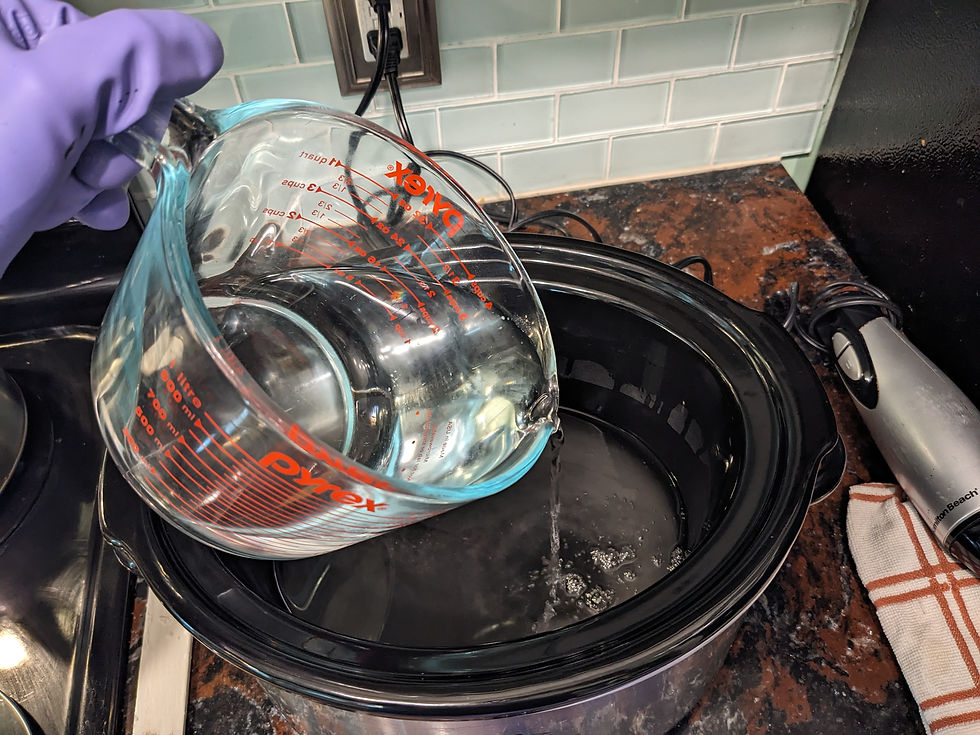
Then the KOH solution was poured into the melted coconut oil. Two very warm clear liquids were mixed together with a immersion blender until the solution became cloudy and thick.

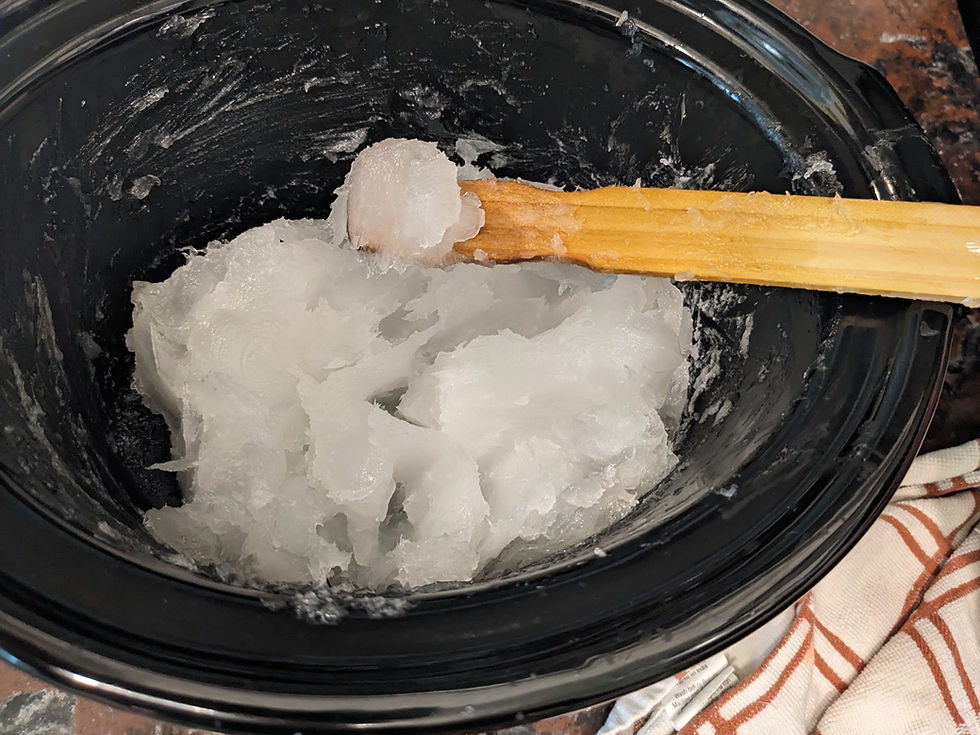
The mixture cooked for 7 hours and resulted in a gelled paste. Water was added to dissolve the soap paste and after another day in the crockpot, I was able to collect my finished soap.
Well, that was the plan. What actually happened was that there was an oily white layer on top of the soap which I came to realize was unreacted coconut oil. When I make solid bar soap, I always add an excess of oil because it makes for a slightly more moisturizing soap. Apparently with liquid soap, the excess unreacted oil just floats to the top of the mixture. I threw the crock pot insert into the fridge overnight to compel the oil to solidify so that I could just pick it off with my fingers, like chicken fat off the top of refrigerated leftover chicken soup. I was able to pull a lot of the excess oil off this way, but not all of it. After trying to scoop off the rest out with a spoon, I poured the soap into a large bottle with a narrow neck and let it settle for several hours. Then I pulled the top layer off with a transfer pipet. It was tedious and time consuming and I have learned why excess oils are not used in liquid soap recipes!

Finally, days later, I had my finished soap. See the bottle of translucent liquid on the left? That's my beautiful coconut oil soap! But I wasn't sure about the optimal dilution for the foaming pumps, so I tested out 3 different concentrations. Ultimately, diluting by 4 times was perfect. It's the soap of my dreams, a lovely translucent liquid that foams and lathers richly!
And now I know for next time, when I make this recipe again next year, that I need to reduce the amount of coconut oil or increase the amount of KOH to avoid the persistent oily layer debacle that added days to my total processing time.

I took this picture to look pretty, but it actually really bugs me because these bottles aren't labeled. I removed the labels just so the picture would look clean. Isn't that crazy? As soon as I finished taking this picture I pulled out my Sharpie and labeled them again.


